You're viewing a sample result. Everyone's mix is different. Take the quiz to find your own main and secondary patterns.

Your results explained

  • Deep Feelers 26%
  • Do-ers 18%
  • Preservers 11%
  • Signposter 20%
  • Information Receivers 25%

Main pattern:

Main motivation: Your tendency is towards emotional connection. Your empathy runs deep, and it shapes how you respond when someone's struggling.

See more about this pattern

You're a safe harbour for heavy feelings. You help people feel truly seen, heard and believed, which eases the shame and isolation that so often come with a hard secret.

Because you feel things so deeply, you can absorb the other person's emotions like a sponge and end up overwhelmed. When that happens, you might reach for quick reassurance ("you're so strong!") instead of just sitting with what's hard, or let your own feelings spill onto the person who came to you.

You're at your best when you protect your own emotional energy. You don't have to feel someone's pain as your own to understand it deeply. Listen without judging, reflect back what you hear ("this sounds really hard"), and let them set the pace, without steering them towards a silver lining or positive.

Applying this to talking about childhood sexual harm: Advice from our resources

Try active listening

Active listening plays a crucial role in supporting survivors. By allowing them to express themselves without judgment, ensuring confidentiality, and respecting their pace, individuals can create a safe space for survivors to share their experiences and emotions. Simply being present and attentive during these conversations is often profoundly impactful. Practicing active listening involves refraining from interrupting and prioritising the survivor's narrative over one's own contributions to the conversation.

Listen · Cultural Sensitivity

Secondary pattern:

Main motivation: You're driven by understanding. You take in the facts and try to see a situation from every angle.

See more about this pattern

You're a deep, focused listener. You gather the details that help everyone understand what's really going on, which matters for judging risk and working out what to do next.

Because you want the facts straight, your questions can sometimes feel intrusive, as if you're playing devil's advocate or asking for proof. Focus too hard on the timeline and you can miss the person’s feelings and cultural meaning underneath.

You're at your best when you use the facts to help the person in front of you, and you know when it's the right moment to ask more. Notice their cultural and community context, and be clear about what you need to know and why.

Applying this to talking about childhood sexual harm: Advice from our resources

Notice behaviour changes when discussing with your partner or friend

The person might not notice themselves that they are acting differently when talking about the abuse. They might get more hungry, or angry, or want more intimacy. Try to make a note of this and talk about it with your partner after the conversation so you can figure out how best to support them after.

Listen · Dating

Do not say "Aren't you worried about people making it up?"

We strongly urge against expressing suspicion towards survivors and emphasize the need for support rather than doubt. We feel frustrated with the common argument accusing survivors of fabricating their experiences, recognizing its historical use to oppress countless victims. While acknowledging the concern of false accusations, we stress its rarity supported by evidence, noting that the majority of survivors coming forward are telling the truth. There are so many more cases of survivors telling the truth than making it up, but tabloid news will tend to focus on the rare case of someone lying.

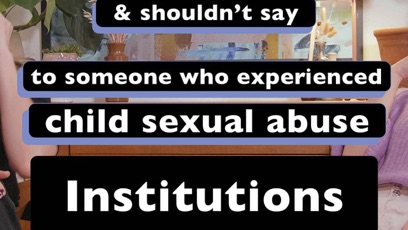
Listen · Institutions

Getting to know the rest of your mix

You have a little of every style in you.

Signposter 20%

You keep things safe and steady because you think about the right steps to take. Just offer people a choice when you point them somewhere, explain why a step matters, and check how they're feeling before the next one.

Applying this to talking about childhood sexual harm: Advice from our resources

Offer to look for institutions and support services together

Sometimes in the event of sharing such a traumatic story of abuse, the survivor might not know what is best for them, or what sort of help they need. Take the time to offer to look for counselling services with them, or charities in the local area that could help. They might want support with taking up a new hobby, like sport or gardening, as a way to distract themselves from the abuse. If they are going through the legal and justice system, offer to take copies of emails between all the different services so that they have a paper trail to help in court. So much of the legal and justice system can be extremely overwhelming and so offering to take some of the administrative tasks off of the survivor's plate can really help them to focus on the important parts of disclosing their story.

Listen · Institutions

Don't force young people into decisions

While you may have research responsibilities to fulfil, or deadlines to meet, ensuring that young people have control and autonomy over their own decisions throughout the research is vital. Give them the space and control to decide how they engage and participate, including the ability to opt out or pause their participation.

Listen · Research with Young People

Do-ers 18%

You turn care into action: a meal, a plan, the right resource found fast. Before you start fixing, ask what kind of help they actually want, and be okay if the answer is none.

Applying this to talking about childhood sexual harm: Advice from our resources

Remind the person that they have choice by saying "No matter what you decide to do, I will respect it"

Instead of telling the person what they should and shouldn't do, actually remind them that they are in control and have choice. Help them to understand that their autonomy will be respected by other people; that disclosure is theirs, including: who they want to say it to, whether they want to report it to the police or not, whether they want help with their mental health, or whether they just want to sit with it for a bit before even making a decision.

Listen · Cultural Sensitivity

Don't offer solutions without context

Often, out of shock or horror or disgust, people want to fix a problem and offer options to the survivor, but that might not be a possible angle for them. For example, the police are a very loaded institution in a lot of Black cultures due to systematic racism, so asking a Black man why they haven't gone to the police may dismiss generational trauma around how police have historically treated Black men in the UK. Take time to understand the person's challenges and what sorts of support they might need.

Listen · Black Men

Preservers 11%

Your calm stops panic taking over and gives everyone room to think. Pair it with a quick "I'm here, I just need a moment" so it never reads as distance.

Applying this to talking about childhood sexual harm: Advice from our resources

Remind the person that they can choose what details they share. For example "If you aren't ready to talk about this detail right now, let's carry on this conversation at a time you feel ready"

A conversation about child sexual abuse doesn't have to be the ONLY conversation about childhood sexual abuse. Handle different elements at different times, based on what feels appropriate. For example, if someone is telling a person about the abuse for the very first time, it might feel overwhelming to suddenly start asking about police and court processes. Instead ask them about what part of the abuse they would like to have a talk about and that can help you to have a more supportive and focused conversation.

Listen · Disclosing

Download the free full methodology report, with your results.

Answer five quick, anonymous questions about the quiz and we'll send you the full findings report, plus the do's and don'ts matched to your style.

You're viewing a sample result. Everyone's mix is different. Take the quiz to find your own main and secondary patterns.

Your results explained

  • Deep Feelers 26%
  • Do-ers 18%
  • Preservers 11%
  • Signposter 20%
  • Information Receivers 25%

Main pattern:

Main motivation: Your tendency is towards emotional connection. Your empathy runs deep, and it shapes how you respond when someone's struggling.

See more about this pattern

You're a safe harbour for heavy feelings. You help people feel truly seen, heard and believed, which eases the shame and isolation that so often come with a hard secret.

Because you feel things so deeply, you can absorb the other person's emotions like a sponge and end up overwhelmed. When that happens, you might reach for quick reassurance ("you're so strong!") instead of just sitting with what's hard, or let your own feelings spill onto the person who came to you.

You're at your best when you protect your own emotional energy. You don't have to feel someone's pain as your own to understand it deeply. Listen without judging, reflect back what you hear ("this sounds really hard"), and let them set the pace, without steering them towards a silver lining or positive.

Applying this to talking about childhood sexual harm: Advice from our resources

DO's

Try active listening

Active listening plays a crucial role in supporting survivors. By allowing them to express themselves without judgment, ensuring confidentiality, and respecting their pace, individuals can create a safe space for survivors to share their experiences and emotions. Simply being present and attentive during these conversations is often profoundly impactful. Practicing active listening involves refraining from interrupting and prioritising the survivor's narrative over one's own contributions to the conversation.
Listen · Cultural Sensitivity

DON'Ts

Secondary pattern:

Main motivation: You're driven by understanding. You take in the facts and try to see a situation from every angle.

See more about this pattern

You're a deep, focused listener. You gather the details that help everyone understand what's really going on, which matters for judging risk and working out what to do next.

Because you want the facts straight, your questions can sometimes feel intrusive, as if you're playing devil's advocate or asking for proof. Focus too hard on the timeline and you can miss the person’s feelings and cultural meaning underneath.

You're at your best when you use the facts to help the person in front of you, and you know when it's the right moment to ask more. Notice their cultural and community context, and be clear about what you need to know and why.

Applying this to talking about childhood sexual harm: Advice from our resources

DO's

Notice behaviour changes when discussing with your partner or friend

The person might not notice themselves that they are acting differently when talking about the abuse. They might get more hungry, or angry, or want more intimacy. Try to make a note of this and talk about it with your partner after the conversation so you can figure out how best to support them after.

Listen · Dating

DON'Ts

Do not say "Aren't you worried about people making it up?"

We strongly urge against expressing suspicion towards survivors and emphasize the need for support rather than doubt. We feel frustrated with the common argument accusing survivors of fabricating their experiences, recognizing its historical use to oppress countless victims. While acknowledging the concern of false accusations, we stress its rarity supported by evidence, noting that the majority of survivors coming forward are telling the truth. There are so many more cases of survivors telling the truth than making it up, but tabloid news will tend to focus on the rare case of someone lying.

Listen · Institutions

Download the free full methodology report, with your results.

Answer five quick, anonymous questions about the quiz and we'll send you the full findings report, plus the do's and don'ts matched to your style.

Getting to know the rest of your mix

Signposter

20% of your mix

Part of your unique mix — rounding out how you show up when someone shares something difficult with you.

More info

You keep things safe and steady because you think about the right steps to take. Just offer people a choice when you point them somewhere, explain why a step matters, and check how they're feeling before the next one.

Do-ers

18% of your mix

Part of your unique mix — rounding out how you show up when someone shares something difficult with you.

More info

You turn care into action: a meal, a plan, the right resource found fast. Before you start fixing, ask what kind of help they actually want, and be okay if the answer is none.

Preservers

11% of your mix

Part of your unique mix — rounding out how you show up when someone shares something difficult with you.

More info

Your calm stops panic taking over and gives everyone room to think. Pair it with a quick "I'm here, I just need a moment" so it never reads as distance.